
What is Ayurveda आयुर्वेद

The word itself is a definition. Ayu means life — not merely the span of breathing, but the union of body, senses, mind and soul. Veda means knowledge, or science. Ayurveda, then, is the science of life: the knowledge of what sustains life, what shortens it, what makes it happy or unhappy, and what measure of it is worth living.
Charaka, in the opening of his Samhita, does not begin with disease. He begins with life, and with the physician's obligation toward it. Disease appears later, as a disturbance in something that was already whole. This ordering is not accidental — it is the whole posture of the system. Ayurveda studies health first, and studies disease only as health's departure.
It is therefore not a treatment for illness alone. Half of Ayurveda — arguably the more important half — concerns the person who is not yet ill: how such a person should eat, sleep, work, and move through the seasons so that illness has no opening. The classical texts call these two aims swasthasya swasthya rakshanam, the preservation of health in the healthy, and aturasya vikara prashamanam, the pacification of disorder in the sick. In that order.
Origins & the Texts
Ayurveda did not arrive at once. It descends through a long line of oral transmission, and only later was it fixed in writing — in Sanskrit verse, arranged to be memorised before it was understood.
The Vedic Root
Ayurveda is traditionally held to be an upaveda — a subsidiary knowledge — of the Atharva Veda, the fourth of the Vedas, which is dense with material on healing, herbs, longevity and the causes of affliction. The Rig Veda, older still, names medicinal plants and speaks of physicians. The seeds are there long before the system is.
The Great Samhitas
What we now study as Ayurveda rests principally on three compendia, the Brihat Trayi or Great Triad:
- Charaka Samhita — the foundational text of Kayachikitsa, internal medicine. Concerned with diagnosis, constitution, ethics of practice, and the physician's conduct.
- Sushruta Samhita — the foundational text of Shalya Tantra, surgery. It describes instruments, incisions, sutures, and reconstructive procedures with a precision that startles the modern reader.
- Ashtanga Hridayam — Vagbhata's later synthesis, which condenses both into a single, teachable whole. It is the text most often placed in a student's hands first.
The Eight Branches
Ashtanga means eight limbs. Classical Ayurveda is not a single discipline but eight:
- Kayachikitsa — internal medicine
- Shalya Tantra — surgery
- Shalakya Tantra — diseases of the eye, ear, nose, throat and head
- Kaumarabhritya — paediatrics and obstetrics
- Agada Tantra — toxicology
- Bhuta Vidya — disorders of the mind
- Rasayana — rejuvenation and longevity
- Vajikarana — vitality and reproductive health
Panchakarma, the purification therapy for which SWAN is principally known, sits within Kayachikitsa — but draws on nearly all the others.
First Principles
Before the body can be treated it must be described, and Ayurveda describes it in a vocabulary older than biology. The vocabulary is elemental — but it is used functionally, not literally. When the texts say fire, they mean everything in the organism that transforms.
Panchamahabhuta · The Five Elements
All matter, the body included, is composed of five great elements: Akasha (space), Vayu (air), Agni (fire), Jala (water) and Prithvi (earth). These are not substances so much as qualities — the principle of movement, the principle of transformation, the principle of cohesion.
Tridosha · The Three Doshas
The five elements combine, in the living body, into three governing forces. These are the doshas, and every physiological process is attributed to one of them.
- Vata governs all movement — breath, circulation, nerve impulse, elimination, and thought itself. When disturbed: dryness, irregularity, anxiety, pain.
- Pitta governs all transformation — digestion, metabolism, body heat, perception, and the intellect's capacity to discriminate. When disturbed: heat, inflammation, acidity, anger.
- Kapha governs all structure and cohesion — the tissues, the lubrication of joints, immunity, and steadiness of mind. When disturbed: heaviness, congestion, stagnation, attachment.
The doshas are not humours to be eliminated. They are the body's working forces. Health is their proportion; disease is their disproportion.
Prakriti · The Constitution You Were Born With
At conception the doshas settle into a proportion unique to each person. This is prakriti, and it does not change across a lifetime. One person is constitutionally Vata-predominant, another Pitta-Kapha, and so on. Prakriti explains why two people eat the same food and only one is troubled by it.
The deviation from that baseline — the state you are in now — is called vikriti. The physician's first task is to determine both: what you are, and how far you have drifted from it. Treatment is the distance between the two.
The Body as Ayurveda Understands It
Agni · The Digestive Fire
If one idea had to stand for the whole of Ayurvedic physiology, it would be agni. Agni is the transformative capacity of the body — most obviously the digestive fire in the stomach, but also the metabolic fire in each tissue and each cell.
Charaka is blunt about it: when agni is balanced, the person is healthy; when agni is disturbed, disease follows; when agni is extinguished, the person dies. Longevity, complexion, strength, immunity and clarity of mind are all held to depend on it. Nearly every Ayurvedic intervention — diet, herbs, fasting, purification — is in some way an intervention upon agni.
Dhatu & Mala · Tissues and Wastes
Food, once digested, is transformed successively into seven dhatus — the bodily tissues, each formed from the one before it:
- Rasa — plasma, the nutrient fluid
- Rakta — blood
- Mamsa — muscle
- Meda — fat
- Asthi — bone
- Majja — marrow and nerve tissue
- Shukra — the reproductive essence
The refinement is sequential: a defect in the first tissue is inherited by every tissue after it. Beyond the seventh is said to arise ojas — the subtle essence of vitality and immunity, the final distillate of good digestion.
What the body cannot use it must expel. The three malas — purisha (faeces), mutra (urine) and sweda (sweat) — are not mere refuse; their regularity is a primary diagnostic sign, and their obstruction is a cause of disease in its own right.
Ama · The Undigested Residue
When agni is weak, food is not fully transformed. What remains is ama — a sticky, undigested residue that circulates, lodges in the channels, obstructs them, and mixes with the doshas. Coated tongue, heaviness after eating, dull appetite, fatigue without cause: these are read as signs of ama.
Ama is the pivot on which the whole of Panchakarma turns. Where a disturbance is mild, the doshas can be pacified in place. Where ama has accumulated deep in the tissues, it must be loosened, drawn back to the digestive tract, and expelled. That is precisely what purification therapy exists to do.
Health & Disease
What Health Actually Means
Sushruta's definition of a healthy person is worth reading slowly, because it refuses to stop at the body:
He is swastha — literally, established in oneself — whose doshas are in balance, whose agni is balanced, whose tissues and wastes are functioning in their proper measure, and whose soul, senses and mind are settled in contentment.
The last clause is not decoration. A body whose numbers are correct but whose mind is disordered is not, by this definition, healthy. This is why yoga, silence and the ordered day are not extras at SWAN — they belong to the definition of the goal.
How Disease Arises
Disease is not an invasion. It is a sequence, and the sequence can be interrupted at any point:
- Wrong diet, wrong conduct, wrong season, or the misuse of the senses weakens agni.
- Weak agni produces ama.
- Ama, with the disturbed doshas, spreads through the channels.
- It settles in a weak tissue or organ — the site where symptoms will eventually appear.
- Only at the last stage does it become the named disease a patient arrives complaining of.
The classical texts name six such stages, and the physician is trained to recognise the earlier ones. By the time a disease has a name, it is already late in its own story. This is the whole argument for preventive practice.
The Two Kinds of Treatment
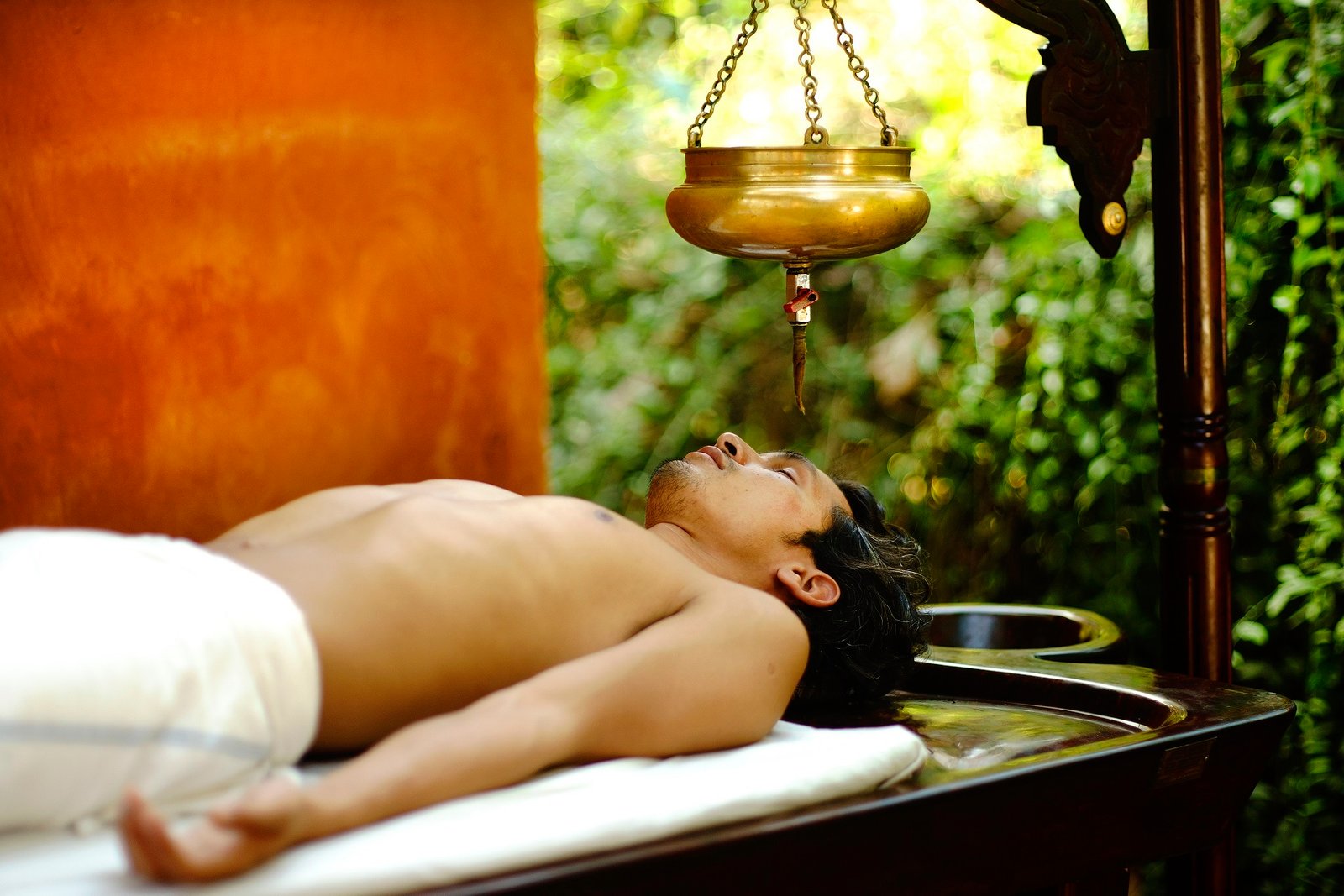
All Ayurvedic treatment falls into one of two categories. Choosing between them correctly is the greater part of the physician's skill.
Shaman Chikitsa · Pacification
Where the doshas are disturbed but not deeply lodged, they can be brought back into proportion where they stand — by medicine, by diet, by fasting, by herbs, by heat or by rest. Nothing is expelled from the body. The disturbance is subdued in place. For a great many conditions this is sufficient, and it is always the first recourse.
Shodhan Chikitsa · Purification
But when the doshas are vitiated beyond a certain threshold, they generate toxins that accumulate in the minute channels of the body. These are past pacifying. They must be removed. This is Shodhan, cleansing therapy — and because it consists of five principal actions, it is known as Panchakarma.
Purification is not a stronger version of pacification. It is a different order of intervention: the body is first prepared with oleation and fomentation, the doshas are drawn from the tissues back to the gut, and only then are they expelled by one of the five routes. Done properly, it resets the ground on which health stands. Done carelessly, it harms. It is never undertaken without a physician.
Dinacharya · The Ordered Day दिनचर्या
Ayurveda holds that the doshas rise and recede through the day in a predictable rhythm — Kapha in the early morning and early night, Pitta at midday and midnight, Vata in the late afternoon and before dawn. A day arranged against that rhythm exhausts the body. A day arranged with it costs nothing and heals continuously.
This is dinacharya: waking before sunrise, cleansing the senses, oiling the body, moving it, eating the principal meal when the digestive fire is highest at midday, and eating lightly at dusk. Alongside it stands ritucharya, the seasonal regimen, which adjusts food and conduct as the year turns.
None of this is treatment in the narrow sense. It is the ground beneath treatment — and it is the reason a residential stay accomplishes what an outpatient visit cannot. At SWAN the day itself is arranged this way, for everyone, whether under therapy or not.
Ayurveda at SWAN
SWAN is a residential, founder-led school and retreat centre in Assagao, Bardez, Goa, run on the principles of an ashram. The founders are the teachers. The physicians are resident. Treatment is prescribed after consultation and adjusted as the body responds — never sold from a menu.
Classical hatha yoga runs alongside the treatment, not as an amenity but because the two arise from the same source and address the same person. Food is sattvic, cooked on the premises, and served at the hours the texts prescribe. Silence is kept from the evening meal until the morning practice.
What we offer is what was passed to us — examined, kept whole, kept honest. The day itself is the practice; the practice is its own authority.
Important health information
The information on this page is provided for general educational purposes and describes Ayurveda and its therapies as set out in the classical texts. It is not medical advice, and it is not a diagnosis, a prescription, or an offer to treat, cure or prevent any disease.
Ayurvedic therapy at SWAN is undertaken as a supportive practice alongside — never as a replacement for — the care of your own doctor. Please do not stop, reduce or alter any prescribed medication except on the advice of your treating physician.
Every guest is assessed individually before any procedure begins, and suitability is determined by the resident physician. Responses vary from individual to individual, and no particular outcome or result is promised or implied.
If you live with a diagnosed medical condition, are pregnant or breastfeeding, or take regular medication, please consult your doctor before booking and tell us in your consultation so your programme can be planned safely.